What Kind of Oil Can I Use in My 1994 Kodiak 400
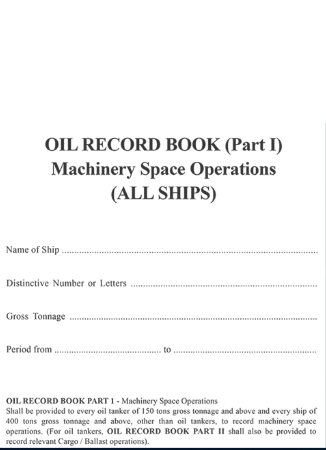
Purpose
- Every oil tanker of 150 gross tonnage and in a higher place
- Every ship of 400 gross tonnage and above other than an oil tanker
Is provided with an Oil Record Book Part I, (ORB) to record oil transfer operation in machinery space as per regulation 17 of MARPOL annex I
This is necessary in social club for government to be able to monitor if a vessel's crew has performed any illegal oil discharge at sea.
Oil record book is retained onboard for 3 years from the engagement of last entry.
The items to exist recorded are listed below:
A – Ballasting or cleaning of oil fuel tanks
B – Discharge of dirty ballast or cleaning water from oil fuel tanks referred to under section (A)
C – Drove, transfer and disposal of oil residue (sludge and other oil remainder)
D- Not Automatic discharge overboard , transfer or disposal otherwise of bilge water which has accumulated in mechanism spaces
E- Automatic starting of discharge overboard, transfer or disposal otherwise of bilge water which has accumulated in mechanism infinite
F- Status of oil filtering equipment
One thousand- Accidental or other exceptional discharges of oil
H- Bunkering of fuel or bulk lubricating oil
- Additional operation procedures and general remarks.
Responsibility
All officers and crew onboard need to recognize that recording of ORB is required by the rules and the records are critical.

In Oil record book part I, Each completed operation shall exist signed by the technology officer in charge and confirmed by the primary engineer.
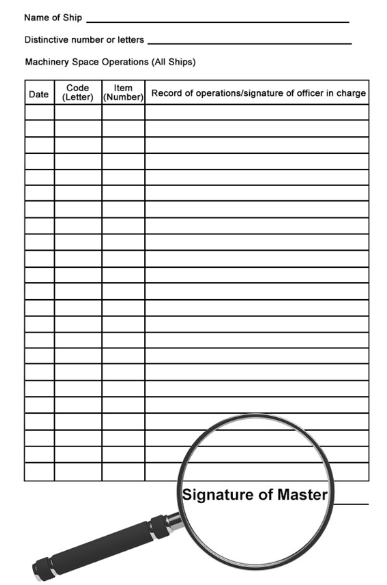
The principal will sign at the lesser of each completed page.
Person carrying out the operation
Operations which take the possibility to result in:
- Belch overboard
- Overflow of oil from tank
Shall be carried out by a certified watchkeeping engineer (duty engineer ) only.

Other operations which cannot result in a discharge overboard or tank overflow may be carried out by a junior engineer acting nether the straight supervision of a certified watchkeeping engineer.
An example of this is the draining of a leakage tank to a sludge tank with verified available chapters.
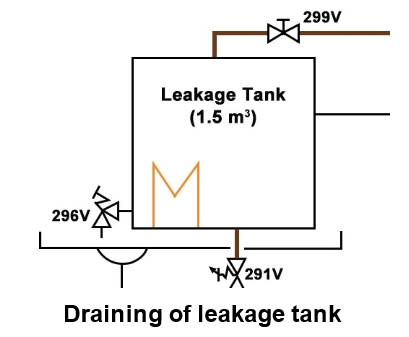
Pumping operations should be carried out but by a certified watchkeeping engineer, specially where error in valve functioning is possible.
Each completed performance shall be signed by the engineering officer in charge and confirmed by the principal engineer. The chief volition sign at the bottom of each completed page.
Oil record book (part I) – Entries
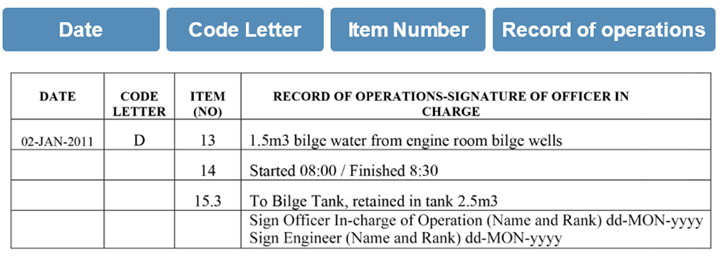
When to brand the Oil tape Book Entry
ORB entry must be fabricated immediately on completion of the operation in English language.
When making entries in the ORB:
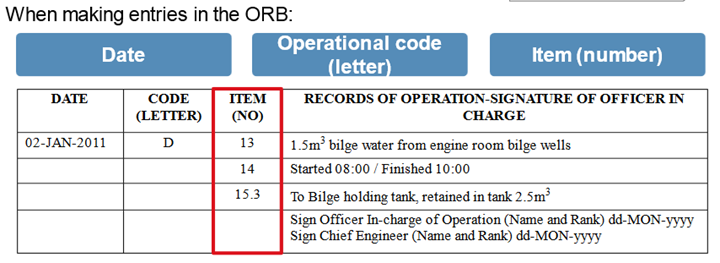
Item numbers shall be inserted in the appropriate columns chronologically.
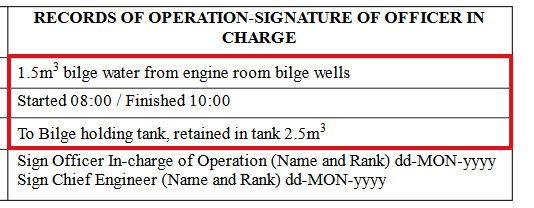
Where a duty engineer makes a number of similar transfers in the course of a sentinel, it is acceptable to enter the total sum of the transfer into the ORB as a single entry.
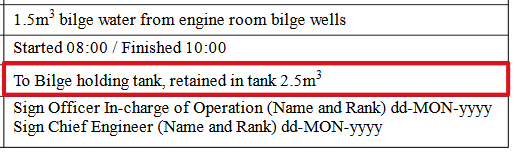
An instance of this might be several bilges pumped from the same infinite to the same bilge property tank.
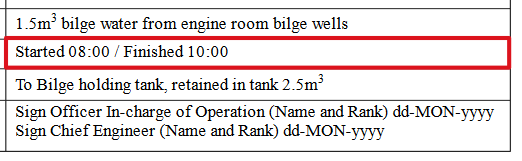
The flow covered must not exceed half-dozen hours and the entry must make it articulate that the transfers were made over such a period.
Person making the Entry
The person making the entry into the ORB must exist the person who is straight responsible for conveying out that item operation.
Normally this would exist a duty engineer.
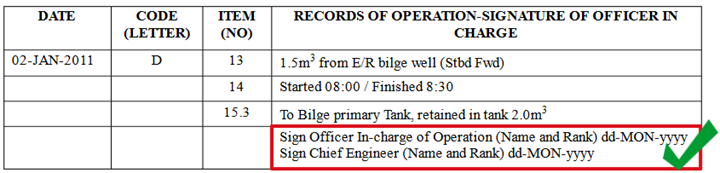
Each completed operation shall be signed past the engineering science officer in charge and confirmed past the chief engineer. The master will sign at the Bottom of each completed page.
Inedible Entries
All entries in the ORB have to exist recorded with indelible ink.

Correcting wrong entries
In case wrong entry has been recorded in the ORB, it should be struck through immediately by a single line such that wrong entry can nevertheless exist read

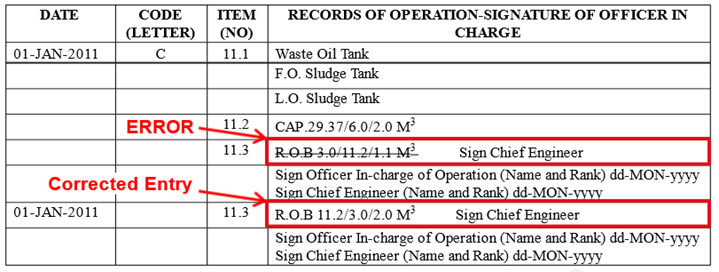

The wrong entry volition be signed by the officer in accuse, and the new correct entry is to be made at the first clear line available below.
Post entry amendment
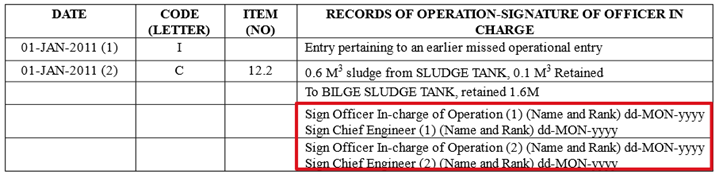
Each entry must exist checked and signed at the primeval opportunity by the chief engineer for accurateness and content. Whatsoever necessary amendments are required to be made inside 24 hours of the functioning carried out.
Amendments are acceptable provided that they are endorsed by both the chief engineer and the duty engineer responsible for the functioning.
Each completed and checked folio of the ORB must be presented to the Main for endorsement without delay i.eastward at the first opportunity during his working 24-hour interval.
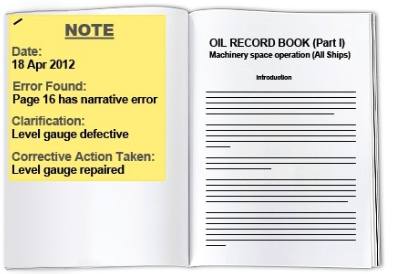
Mistake constitute at a Later Date
If at a afterward appointment, ORB entries are found to exist in error or require to exist antiseptic (such as during an audit or internal review), a notation of the relevant findings and any cosmetic actions is to be attached to the inside encompass of the relevant ORB.
No farther action is necessary
The presence of the findings should be accepted by 3rd parties as proof of effective audit and review procedures and the affected entry should not be construed to be a electric current deficiency in the ORB.
ORB Entries and IOPP Certificate
Entries in ORB such as:
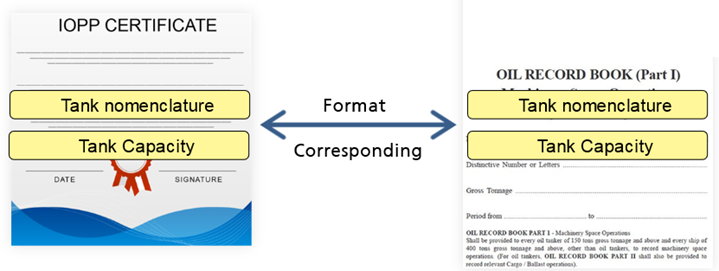
- Tank classification should be recorded as per the format noted within the IOPP document
- Chapters of the tank should be recorded equally corresponding with the chapters of the tank written in the IOPP certificate.
- Oily water separator discharge must not exceed the discharge rate shown in IOPP certificate.
ORB Entries and space
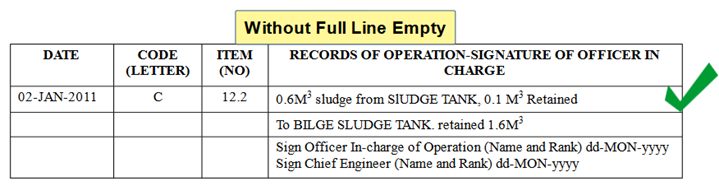
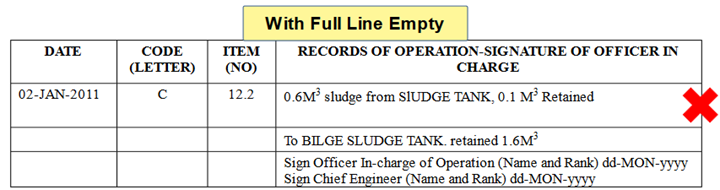
It is not permitted to leave whatever full lines empty between entries (information technology might perhaps go a target of suspicion, with a total line giving space to add a false entry for the purpose of modifying the record.)
Code Letter of the alphabet
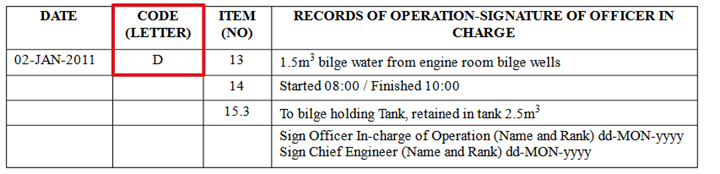
It is essential that the appropriate lawmaking messages are assigned, in order to identify the type of liquid being transferred.
Lawmaking "D" or "E" must be assigned where bilge water is concerned.
For instance, code "C" must exist assigned where oil residues and sludge are concerned.
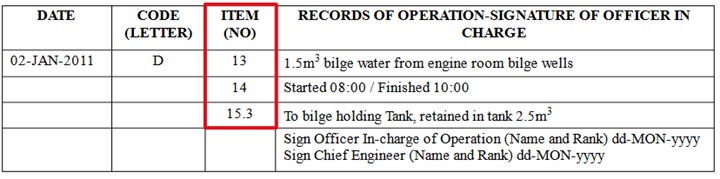
Item Number
The item number must exist chosen with great intendance, every bit feel has shown that the item number is often differently interpreted by third parties.
Tape of Operations
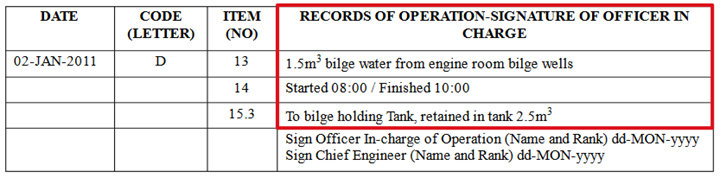
Care must be taken to ensure that the record clearly identifies the exact performance which has been carried out.
Supporting relevant information such as quantity, start and finish fourth dimension, position etc. must be supplied as required.
Adequate standard of Entry
Every effort must be made to ensure that the right date, code letter, item number, record of operations and signatures are entered when making the ORB entry.
Transfer of bilge h2o to the bilge holding tank (if bilge primary tank is non fitted or non used)
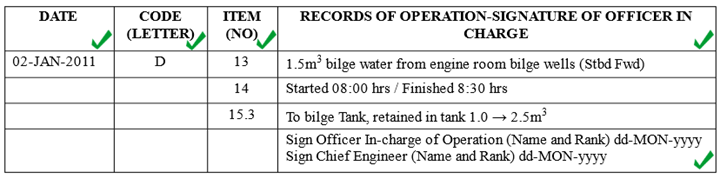
Al v items are required to be entered before the entry tin be considered to be complete.
- The flag state require that the (i) Date (2) Code letter (iii) Item number and (4) Tape of operations clearly identify the potential pollutant and the associated performance which has been carried out, with (v) signature of officer in charge.
- With to a higher place required information given, the requirement of the ORB entry has been satisfied.
Automated and Non Automated belch of disposal
Confusion has arisen regarding:


The term Not-automatic is deemed to refer to the mode of starting, rather than a description of the capabilities of the system in operation.
For example, if a organization fitted with automatic recirculating, alarm and stop functions is manually started, then entries under "D" are appropriate.
Code "E" is applicable if the vessel is fitted with automatic bilge discharge organisation, in which case the bilge pump starts automatically as the bilge well level goes high.
Other methods
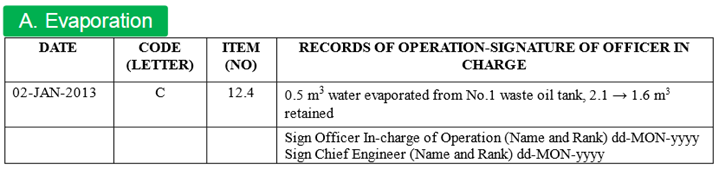
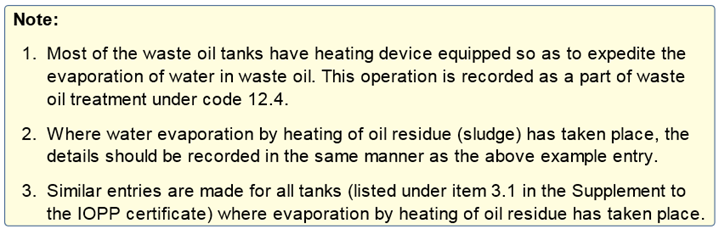
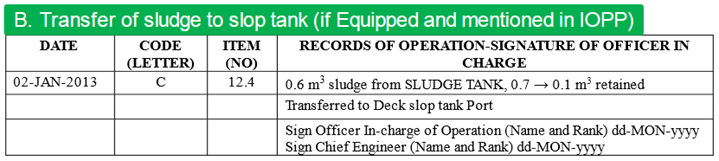
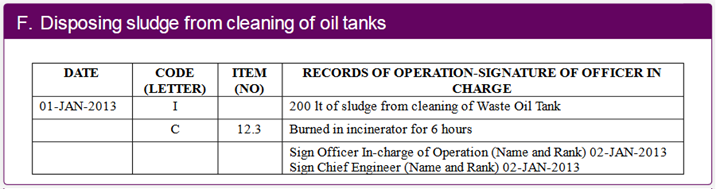
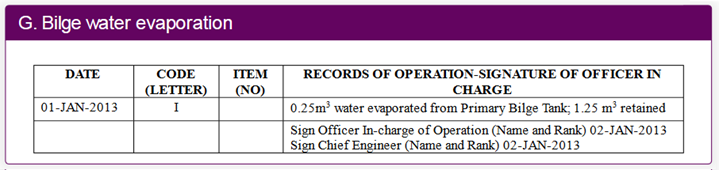
Other methods of disposal (code of C, item no 12.4) have to be recorded for east.g evaporation loss of water from waste matter oil setting tank
Discharge Bilges to Slop Tanks : Code letter "D"
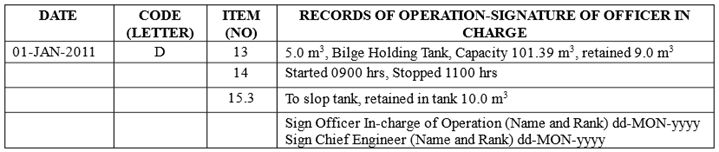
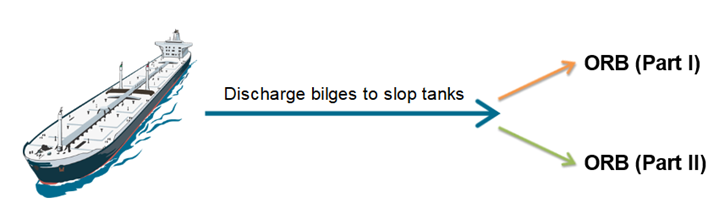
If a vessel has an blessing for discharging engine room bilges to slop tanks, entry must be made both in ORB (Part I), lawmaking letter of the alphabet "D" & item numbers xiii,xiv,15.3, every bit well as ORB (Part II, code alphabetic character J) in case of such transfers.
Bunkering of Fuel or Bulk Lubricating Oil : Code Letter "H"
- Place of bunkering
- Time of bunkering
- Type and quantity of fuel oil and identity of tanks (land quantity added, in tonnes and full content of tanks)
- Type and quantity of lubricating oil and identify tanks (state quantity added, in tonnes and total content of tanks)
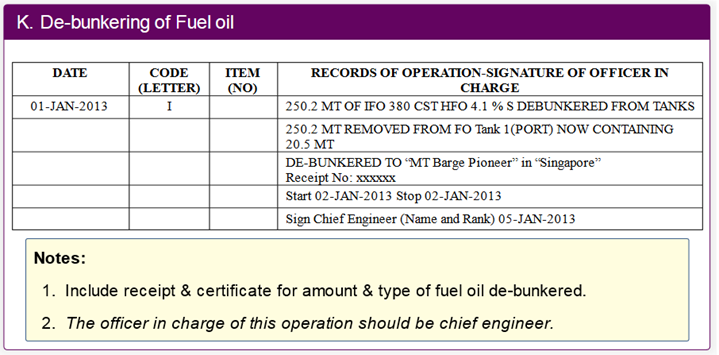
- In case fuel oil and/or lubricating oil is un-loaded onshore (de bunkering) for some reason, this should exist recorded in code "I"
- Every bit for lubricating oil, however, it does non have to exist recorded of the oil in drum is loaded, for instance (i.eastward not loaded in majority)
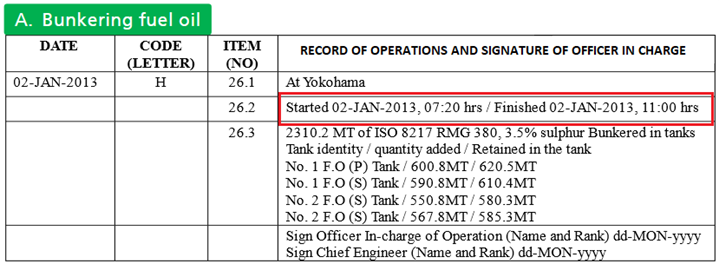
- Showtime and cease time shown in a higher place should lucifer with the bunker delivery note.
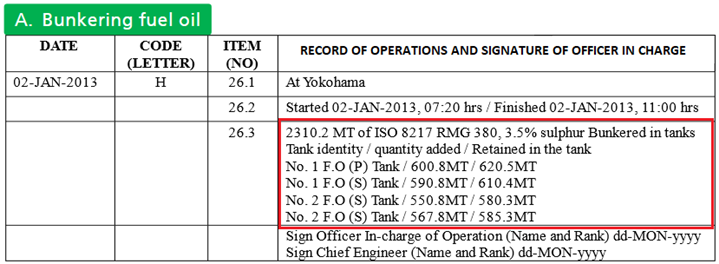
- The total quantity loaded should also match with the quantity shown on the bunker commitment annotation.
- In case yous have taken diesel fuel oil also, please make a complete separate entry as you will take a separate bunker delivery notation for diesel oil.
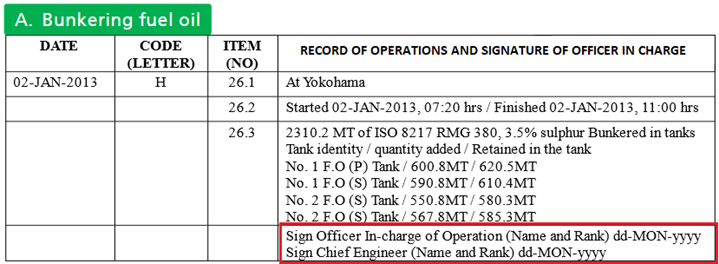
- The officer in charge of the operation under code-H should be chief engineer.
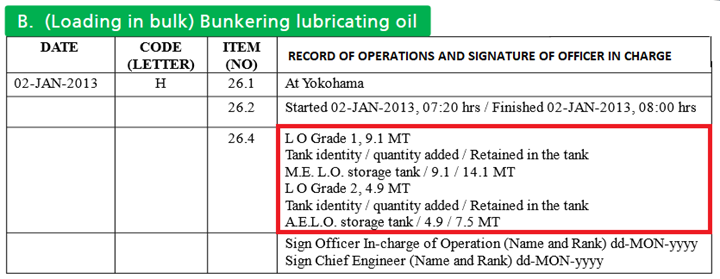
- All the unlike graded of bulk lubricating oil received can exist recorded in a single entry.
- The quantity has to exist entered in metric tons, therefore multiply the volume of the lube oil with the specific gravity. (refer to your lube oil supplier transmission) in guild to go the metric tons (MT)
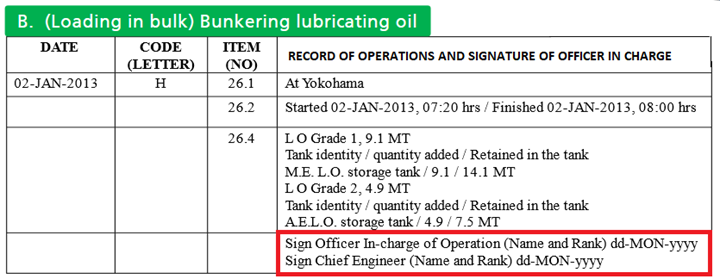
The officeholder in charge of the operation under code-H should be chief engineer.
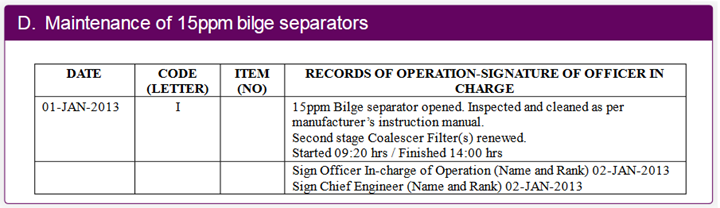
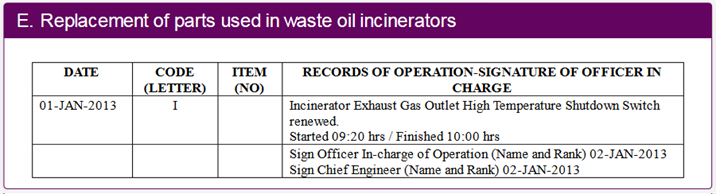
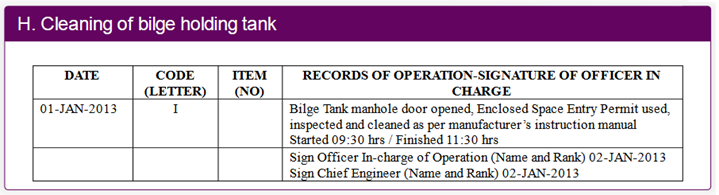
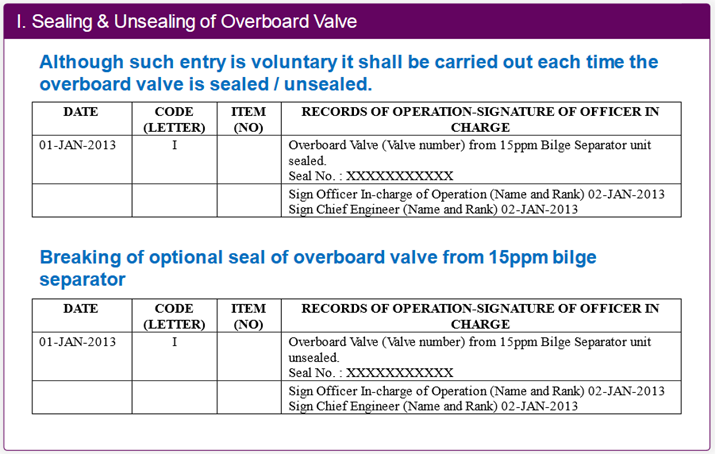
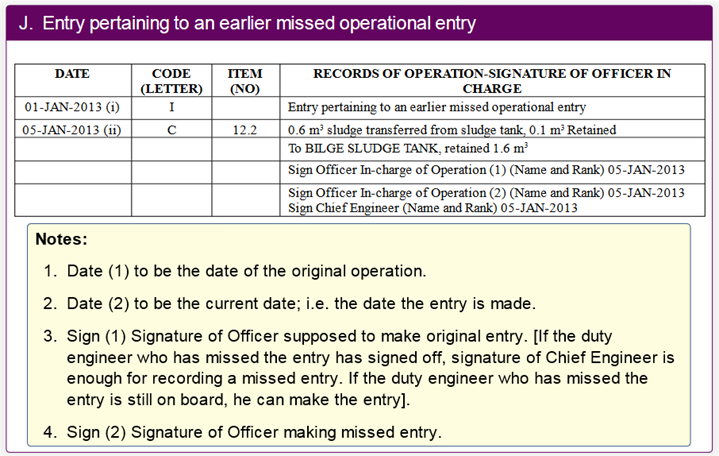
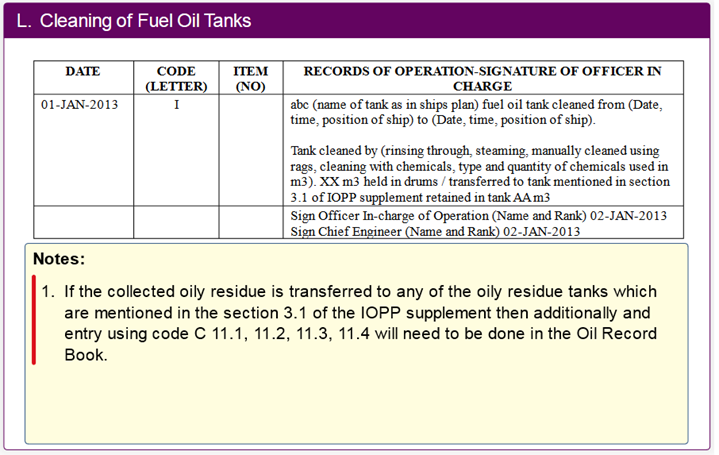
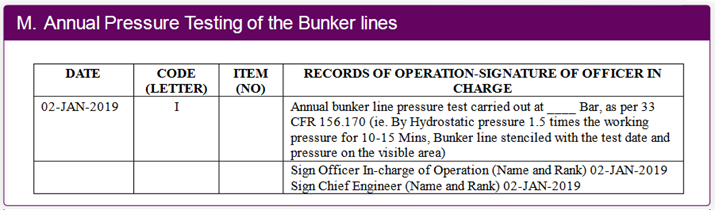
Boosted operation procedures and general remarks code letter "I"
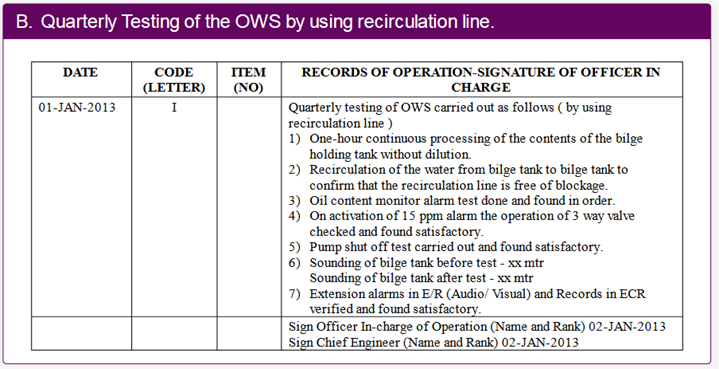
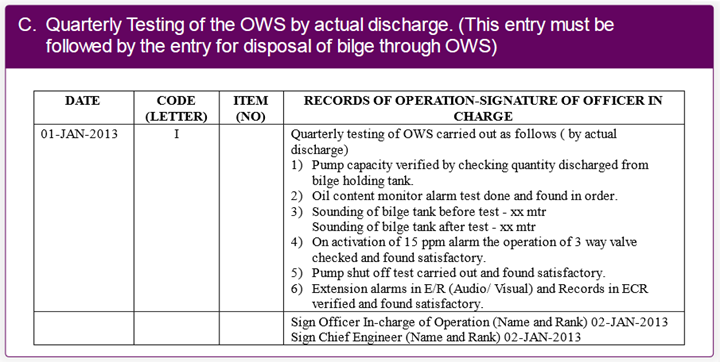
- Items such as maintenance of bilge separators and operational exam for oil content monitor which are equipment listed in IOPP certificate supplement, specifically on how they were carried out.
- However, it excludes contents related with the daily maintenance such as cleaning of bilge suction strainers.
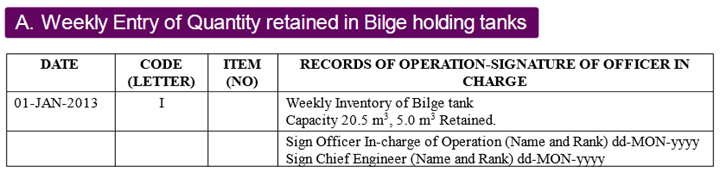
- There are no codes for specific tasks, so tape must be clear and to the bespeak. Refer to the sample entries beneath for more details.
- According to the MEPC round (MEPC.ane/Circ.640/Rev.2), the quantities retained on board in bilge holding tanks should be recorded weekly.
Specific Guidelines for Masters and Primary Engineers
- ORB must exist duly recorded and signed (after each completed entry, both duty engineer and Chief engineer to sign)
- Master to sign each completed page.
- The ORB part I should be shown to the PSC (or any authorized person) in the presence of the chief engineer and all the questions related to the entries made, must be answered directly by him.
- The ORB role I is kept in the personal custody of the master engineer and he is responsible for the proper upkeep of the oil record books.
- Certificate and education manuals of following equipment's must be readily bachelor with the master engineer.
- 15ppm bilge separator
- Oil content monitor
- Automated stopping device
- Waste Oil incinerator
- Aux boiler in instance if used for waster oil incineration
- ODMCS
- The IOPP certificate and supplement must be readily available with chief engineer for corss verification with the ORB by the PSC inspector.
- The receipts obtained after discharging waste matter oil or dingy water to shore facilities must be kept in the safety custody of the chief engineer, attached to ORB.
- Shore facility discharging receipt
- Master engine air libation condensation tin can exist big quantity especially in tropical climates. (Delight ensure that this water is disposed through 15ppm equipment unless there is dedicated clean water tank for collecting this clean h2o.)
- A re-create of schematic pipeline diagram for bilge and sludge system should be displayed near OWS and 1 boosted re-create should be available with the chief engineer for reference. The same is applicative for ODMCS which should be available with chief officer.
- At least one spare new re-create of ORB must exist bachelor onboard.
Source: https://knowledgeofsea.com/oil-record-book-part-i/
Belum ada Komentar untuk "What Kind of Oil Can I Use in My 1994 Kodiak 400"
Posting Komentar